How FINEX reviews a broker
FINEX reviews brokers across legal protection, total costs, withdrawals and trading conditions. Learn how evidence and updates shape each review.
FINEX may earn affiliate revenue through commercial relationships. That revenue is excluded from the review score and does not add rating points.
Trading financial products involves risk of loss. This explanation of FINEX’s review method is informational, not investment advice or a recommendation to trade.
Quick summary
- FINEX assesses four pillars: legal protection, total costs, withdrawals or payouts, and trading conditions.
- The scope must match the exact entity, account, country and program.
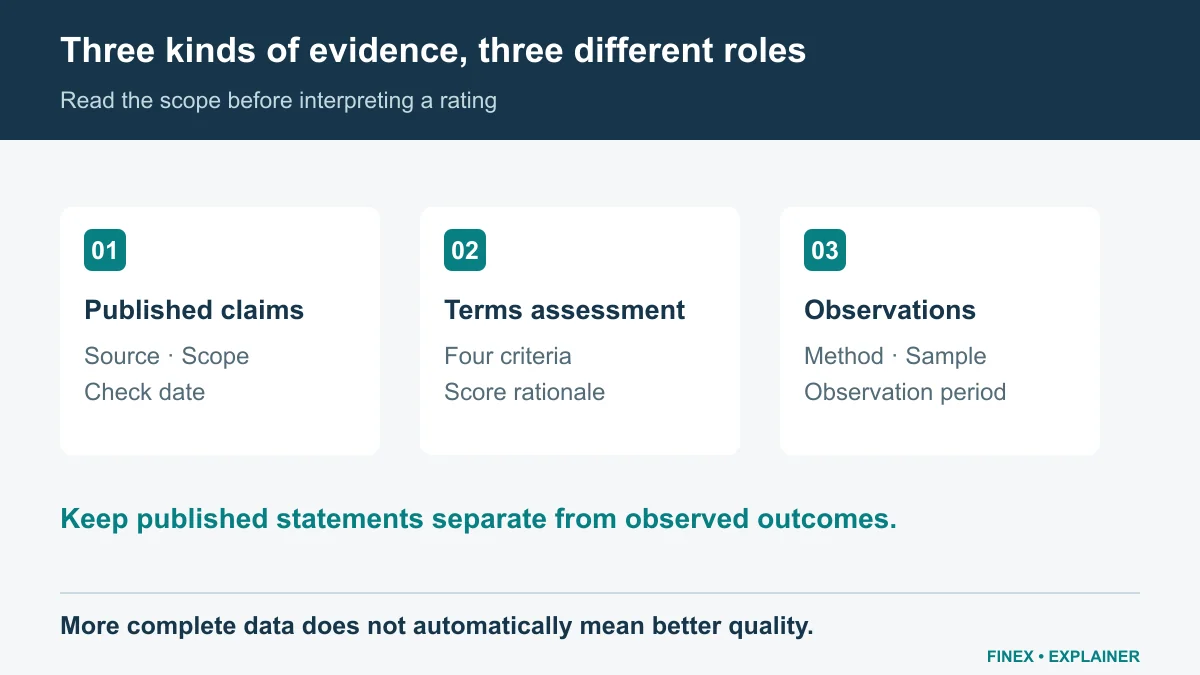
- Published terms, provider claims and observed outcomes are labelled separately.
- Commercial or affiliate revenue is not part of the score.
The four review criteria
For brokers, FINEX assigns 30% to legal protection, 25% to total costs, 25% to withdrawals and 20% to trading conditions. These are weights in FINEX’s editorial framework, not a market ranking. Each profile names the entity, account, country and product covered by its evidence.
Legal review checks the contracting entity, current permissions on the relevant regulator’s register, client-money segregation, negative-balance protection and applicable complaint or compensation routes. A group licence does not cover every entity, and company registration is not brokerage authorisation.
Cost review covers measured spread, round-turn commission, overnight financing, conversion, inactivity and withdrawal charges. Comparisons use the same instrument, lot, account, currency and observation window; a minimum spread alone is not a typical cost. Trading-condition review covers execution, slippage, rejections or requotes, outages, order controls and strategy restrictions under comparable sessions.
Withdrawals and evidence checks
For brokers, FINEX examines completed withdrawal records, total time to customer receipt, fees, available methods, return-to-source and identity-check rules, unexplained delays and complaint handling. Internal processing time is separate from bank or payment-provider receipt. A published process states a rule; it does not prove every customer receives funds on time.
FINEX records each source, its scope and check date. Terms are matched to the account and region; where authorisation applies, the relevant register is checked independently. Provider statements and customer comments can raise questions, but do not prove execution quality or successful payment. Partial evidence and conflicts remain visible.
An evidence-assessed quality score needs documented evidence and comparable outcomes for every pillar. Missing or materially conflicting evidence leaves the assessment pending; FINEX does not fill gaps with an invented neutral score. Preliminary estimates, if shown, are labelled separately.
Commercial independence and updates
FINEX’s published method excludes affiliate revenue from the score formula. A commercial relationship does not add rating points. Reviews assess documented terms and evidence within a stated scope; they do not guarantee safety, returns or future service. Disclosure and score rationale are separate information.
Material changes to fees, legal status, payout terms or trading rules trigger reassessment. Sources older than 90 days are refreshed before a new evidence-assessed rating. FINEX records the rubric version, check date and reason for a change. Readers should still review current provider terms.
Read the full methodology
The full methodology sets out the criteria, scoring anchors, evidence requirements and conflict policy. This article summarizes that framework and does not replace the scope notes or sources on an individual profile.
FINEX — Published broker review methodology FINEX — Phương pháp đánh giá sàn
FAQ
Does an affiliate relationship increase a broker’s score?
No. FINEX’s published methodology excludes affiliate revenue from the score formula; a commercial relationship does not add rating points.
Does an official policy prove that withdrawals or execution work as described?
No. A published policy establishes what the provider says the terms are. FINEX distinguishes those statements from documented or independently observed outcomes.
When does FINEX update a review?
Material changes to fees, legal status, payout terms or trading rules trigger reassessment. Sources older than 90 days are refreshed before a new evidence-assessed rating.
Sources and scope
Sources are provider publications. Conditions may vary by entity, country, account and program. Recheck before signing up.